

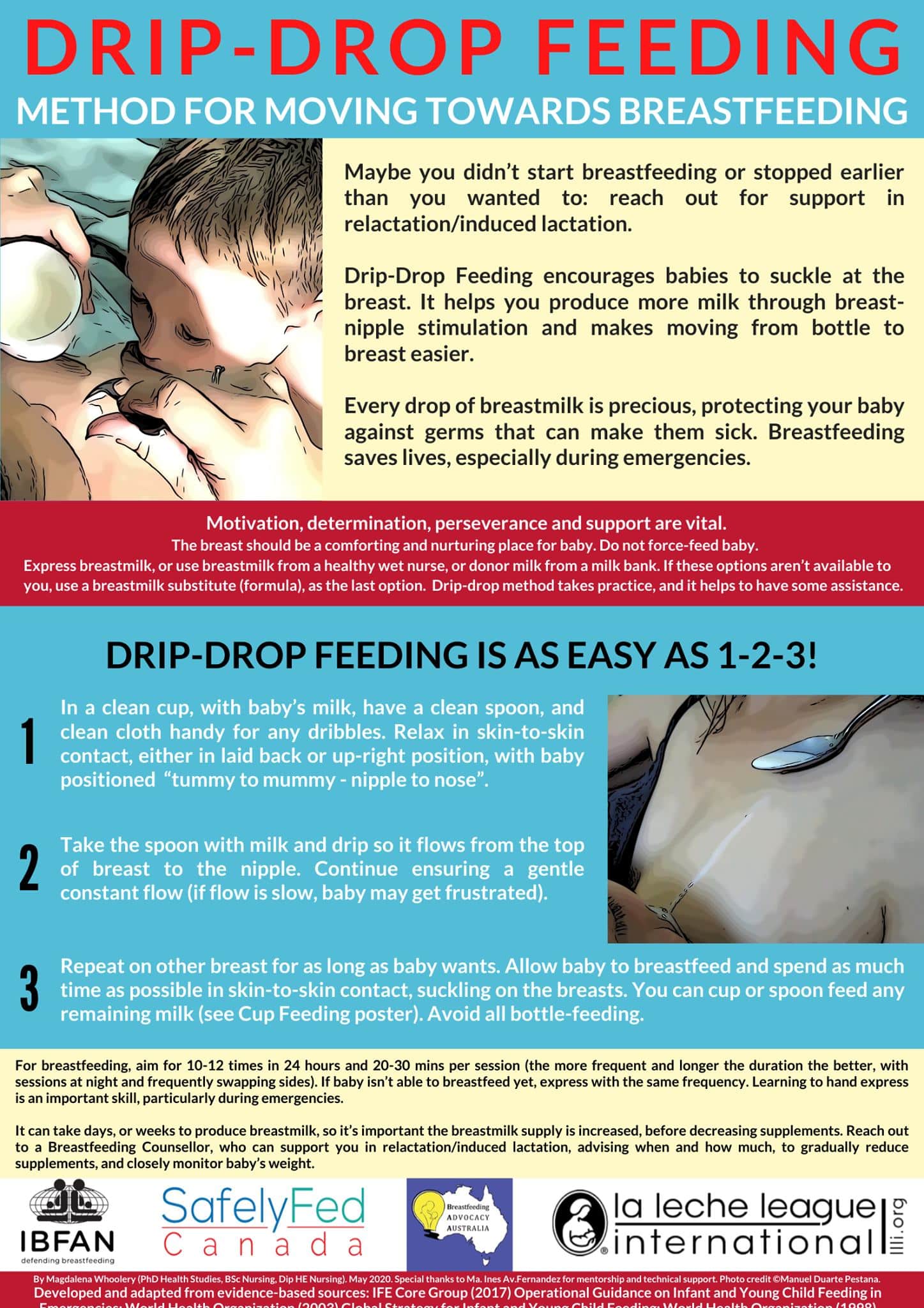
DRIP-DROP FEEDING METHOD FOR MOVING TOWARDS BREASTFEEDING
Drip-Drop Feeding
Maybe you didn’t start breastfeeding or stopped earlier than you wanted to: reach out for support in relactation/induced lactation.
Drip-Drop Feeding encourages babies to suckle at the breast. It helps you produce more milk through breast-nipple stimulation and makes moving from bottle to breast easier.
Every drop of breastmilk is precious, protecting your baby against germs that can make them sick. Breastfeeding saves lives, especially during emergencies.
Motivation, determination, perseverance and support are vital.
The breast should be a comforting and nurturing place for baby. Do not force-feed baby.
Express breastmilk, or use breastmilk from a healthy wet nurse, or donor milk from a milk bank. If these options aren’t available to you, use a breastmilk substitute (formula), as the last option. Drip-drop method takes practice, and it helps to have some assistance
DRIP-DROP FEEDING IS AS EASY AS 1-2-3!
- In a clean cup, with baby’s milk, have a clean spoon, and clean cloth handy for any dribbles. Relax in skin-to-skin contact, either in laid back or up-right position, with baby positioned “tummy to mummy – nipple to nose”.
2.Take the spoon with milk and drip so it flows from the top of breast to the nipple. Continue ensuring a gentle constant flow (if flow is slow, baby may get frustrated).
3.Repeat on other breast for as long as baby wants. Allow baby to breastfeed and spend as much time as possible in skin-to-skin contact, suckling on the breasts. You can cup or spoon feed any remaining milk (see Cup Feeding poster). Avoid all bottle-feeding.
For breastfeeding, aim for 10-12 times in 24 hours and 20-30 mins per session (the more frequent and longer the duration the better, with sessions at night and frequently swapping sides). If baby isn’t able to breastfeed yet, express with the same frequency. Learning to hand express is an important skill, particularly during emergencies.
It can take days, or weeks to produce breastmilk, so it’s important the breastmilk supply is increased, before decreasing supplements. Reach out to a Breastfeeding Counsellor, who can support you in relactation/induced lactation, advising when and how much, to gradually reduce supplements, and closely monitor baby’s weight.